
Attached and detached garages, one to four stalls
Garage Floor Epoxy in Appleton, WI
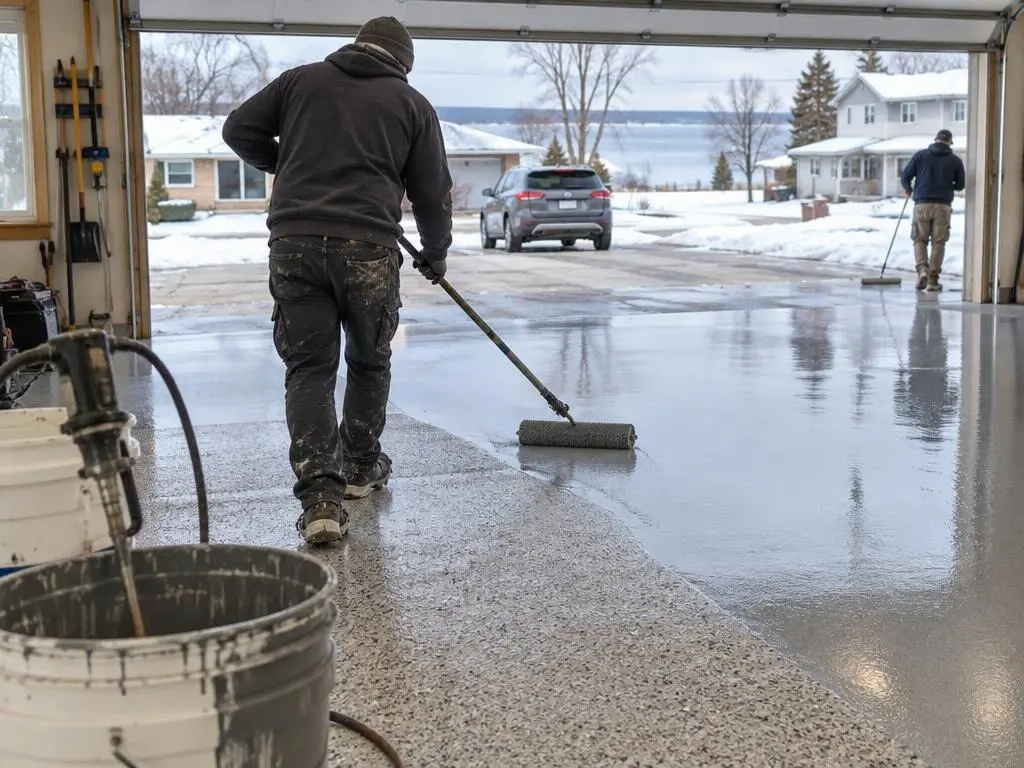
A sealed garage floor that keeps winter slush on the surface and out of the concrete.
- Free on-site estimate with a slab moisture check
- Itemized written quote: prep, coats, square footage, total
- Every floor diamond ground and patched before coating
Why Fox Cities Garages Wear Out First
Garage floor epoxy is the job most Appleton homeowners call about, and the garage is where concrete takes the worst beating. Snow season runs from November into April, and every trip home leaves a puddle of slush and road brine under the car. Bare concrete soaks it in. Over a few winters you get a rough, flaking strip inside the door, pitting in the tire tracks, and dust that comes back no matter how often you sweep. A coating seals the surface so the brine stays on top, where you can squeegee it out the door.
What brine does to bare concrete
Concrete is full of tiny pores. Salt water fills them, and when the slab freezes and thaws, the water expands and the salt adds its own pressure. A 2008 literature review by the Michigan Tech Transportation Institute for the South Dakota DOT describes sodium chloride damage as "usually in the form of severe scaling" and calls magnesium chloride more damaging than sodium chloride because it breaks down the cement paste itself. The worst spots are near the door, where meltwater collects and temperatures swing most, and at the apron joint.
How to tell your garage slab needs work
- Flaking or a rough, sandy surface near the door and under the tires
- White salt rings where puddles dried
- Oil, coolant or transmission fluid stains that have soaked in
- A painted or kit-coated floor peeling in the tire paths
- Cracks, chipped joints, or a low spot where water stands
- Constant concrete dust on whatever you store on the floor
Older garages in Appleton
About a fifth of Appleton's housing was built in 1939 or earlier, and the median home dates to 1971, according to 2019 to 2023 American Community Survey figures summarized by Point2Homes. In older neighborhoods that often means a detached garage on a thinner slab that may slope, crack or hold water. Many of those floors have been painted or sealed more than once. Newer subdivisions on the edges of the Fox Cities tend to have flatter, larger attached garages, but they still take a full winter of salt and can have shrinkage cracks from the first few years.
Prep is the part that matters
Most failed garage coatings never bonded properly. Acid etching, which most store kits use, cleans the surface but leaves sealers and weak, salt-damaged concrete in place. We grind the entire slab with diamond tooling, including the edges along the walls, and collect the dust with a vacuum attached to the grinder. Old paint or epoxy is ground off. Oil spots are degreased. Cracks, spalls and pits are filled with a repair material that cures hard enough to grind flush. Only then does the base coat go down.
Picking a finish
- Full flake: chips broadcast until the base is covered. Hides salt film and grit between cleanings and adds grip.
- Partial flake: a solid color with a lighter scatter of chips for a cleaner look.
- Solid color with anti-slip grit: the plainest finish, with aggregate in the topcoat so it is not slick when wet.
Any of these can take a polyaspartic or urethane clear coat for UV and abrasion resistance. We bring samples so you can see the colors in your own garage light.
Living with it through the winter
A coated floor is easy to clean, but brine still should not sit for weeks. Keep a floor squeegee by the door, rinse the floor a few times through the salt season, and consider a containment mat under each car. Plastic snow shovels are fine; steel-edged shovels and tire chains can scratch the surface.
Timing
Standard epoxy can be walked on after about 12 hours and driven on after about three days, according to Bob Vila's coating guide. HomeGuide puts the full cure for solid epoxy at about seven days. Cold slabs slow everything down, so we give you times based on the actual product and the temperature in your garage.
What This Covers
A garage floor epoxy job runs from the door threshold to the back wall, plus any extras you choose.
Full-slab diamond grinding
The whole floor and the wall edges ground to remove salt-weakened concrete, old paint and sealer.
Crack, pit and joint repair
Cracks and spalls filled and ground flush; control joints filled or left open, your choice.
Base, color or flake, and clear coat
A bonded epoxy base, your chosen finish, and a chemical-resistant clear topcoat with slip texture.
Steps and stem walls
The coating carried onto entry steps and the short concrete curb along the walls if you want a finished edge.
Typical Garage Floor Epoxy Costs
| Garage | Published range |
|---|---|
| Installed epoxy, per square foot | $4 to $10 |
| One-car garage (288 to 392 sq ft) | $1,200 to $3,900 |
| Two-car garage (400 to 576 sq ft) | $1,600 to $5,800 |
| Three-car garage (576 to 864 sq ft) | $2,300 to $8,600 |
| Two-car garage, polyaspartic instead | $2,000 to $6,900 |
| Crack and chip patching | $25 to $250 |
National ranges from HomeGuide (epoxy and polyaspartic cost guides) and HomeAdvisor (patching). Appleton prices can differ, and old coatings, salt damage and the finish you choose change the total. Your written estimate is the price.
How It Works
1. Estimate visit
We measure, look for scaling, cracks, oil and old coatings, and show you finish samples.
2. Grind and patch
Diamond grinding with dust collection, then crack and spall repair.
3. Coat
Base, color or flake, and clear coat, usually over one or two days.
4. Cure and park
Written times for walking, moving items back and parking, based on product and slab temperature.
Garage Floor Epoxy Questions
How much does garage floor epoxy cost for a two-car garage in Appleton?
HomeGuide's national range for a 400 to 576 square foot garage is about $1,600 to $5,800 for epoxy and $2,000 to $6,900 for polyaspartic. Removing an old coating, repairing salt scaling and choosing full flake push the number up. We give you a written price after seeing the slab.
How long does garage floor epoxy last?
HomeGuide lists solid (100% solids) epoxy at 10 to 20 years and water-based coatings at 3 to 5 years. Prep, topcoat choice and how the floor is cared for in winter make the biggest difference.
Will the floor be slippery when snow melts off the car?
A smooth gloss coating can be slick when wet. Full flake floors have built-in texture, and on solid-color floors we add an anti-slip aggregate to the topcoat.
Can you coat over my old garage paint?
No. Paint and old kit coatings are ground off first, because a new coating is only as strong as whatever it sits on. If a layer is already peeling, everything under it is suspect.
Garage Floor Epoxy Service Areas
- Epoxy Flooring in Appleton, WI
- Epoxy Flooring in Grand Chute, WI
- Epoxy Flooring in Neenah, WI
- Epoxy Flooring in Menasha, WI
- Epoxy Flooring in Fox Crossing, WI
- Epoxy Flooring in Kaukauna, WI
- Epoxy Flooring in Little Chute, WI
- Epoxy Flooring in Kimberly, WI
- Epoxy Flooring in Combined Locks, WI
- Epoxy Flooring in Harrison, WI
- Epoxy Flooring in Sherwood, WI
- Epoxy Flooring in Greenville, WI
- Epoxy Flooring in Hortonville, WI
- Epoxy Flooring in Freedom, WI
- Epoxy Flooring in Buchanan, WI
- Epoxy Flooring in Clayton, WI
- Epoxy Flooring in Oshkosh, WI
- Epoxy Flooring in Winneconne, WI
- Epoxy Flooring in De Pere, WI
- Epoxy Flooring in Wrightstown, WI
- Epoxy Flooring in New London, WI
- Epoxy Flooring in Black Creek, WI
- Epoxy Flooring in Chilton, WI
Get a Garage Floor Epoxy Estimate
Free garage floor estimates in Appleton and the Fox Cities.