
Our home base on the Fox River
Epoxy Flooring in Appleton, WI
We coat garage, basement and shop floors across all three counties Appleton reaches into, with prep matched to the age of the slab.
- Free on-site estimate with a slab moisture check
- Itemized written quote: prep, coats, square footage, total
- Every floor diamond ground and patched before coating
One City, a Century and a Half of Concrete
Epoxy flooring in Appleton is our everyday work, and no two Appleton slabs are quite alike. The city was settled in 1847 and became a city in 1857, and it has been pouring garage floors, basement slabs and mill floors ever since. The 2020 census counted 31,747 housing units here. Some sit on concrete poured before World War II, some on slabs from the postwar ranch years, and some on floors that went in last summer. The coating can be the same. The prep almost never is.
Appleton by the numbers that matter for a floor
- Three counties: most residents live in Outagamie County, but the 2020 census counted 11,304 in the Calumet County part of the city and 1,441 in Winnebago County.
- Weather swings: the record high is 107°F, set during the 1936 Dust Bowl, and the record low is −32°F, from 1929.
- Wet seasons: the city averages 33.15 inches of precipitation and 49.4 inches of snow a year.
- Home values: the 2024 American Community Survey puts the median owner-occupied home at $269,300, which is why many owners want a floor that lasts as long as they stay.
Garages we see, by era
Pre-war detached garages. Many of the oldest homes have a single-stall detached garage behind the house. The slabs are thin by today's standards, often uneven, and many have a low spot that holds meltwater. We grind off whatever paint is left, fill the pits, and usually recommend a flake system because it hides the slab's wavy surface.
Postwar and 1960s to 1970s attached garages. This is the biggest group in the city. These floors have had decades of tires, salt and oil. Expect cracks that run from the corners of the door, a scaled strip near the apron, and at least one old coating attempt. They need full grinding and crack repair before any coating.
New construction. Newer homes on the city's edges have dense, smooth, hard-troweled slabs. A coating will not grip that glassy surface until it is ground open. New concrete also needs time to dry out before we coat it, so we ask when the slab was poured.
The Miller Electric effect
Wikipedia lists Miller Electric, the welding equipment maker, among Appleton's five largest employers with about 1,400 workers. In a city with that kind of trade base, plenty of garages double as workshops. Welding spatter, grinding sparks, cutting oil and rolling tool chests are hard on thin coatings. For those floors we suggest a thicker 100% solids epoxy base with a broadcast flake and a tough clear topcoat. It costs more than a basic garage system and holds up better to a dropped vise or a hot bead of slag.
Basements under older houses
Appleton's older houses often have basements with a laundry corner, a furnace and a floor drain, plus a slab that has been painted gray at least once. Before we coat a basement we look for efflorescence, damp patches near the walls and old paint lifting in sheets. Those are signs that moisture is moving through the slab. A moisture test tells us whether a standard epoxy will hold or whether the floor needs a moisture-tolerant primer first. If water is actually coming in, we say so and stop there until it is fixed.
Which system fits which Appleton floor
- Daily-driver garage with salt season traffic: flake epoxy or a polyaspartic flake system with a textured topcoat.
- Garage you need back fast: polyaspartic, which cures quicker and handles cooler slabs better than standard epoxy.
- Finished basement or bar area: metallic epoxy if you want a showpiece, or a solid color with a light texture for a laundry and storage floor.
- Home shop or small commercial bay: a thicker shop-grade epoxy with chemical-resistant topcoat.
Cold-season installs in an Appleton garage
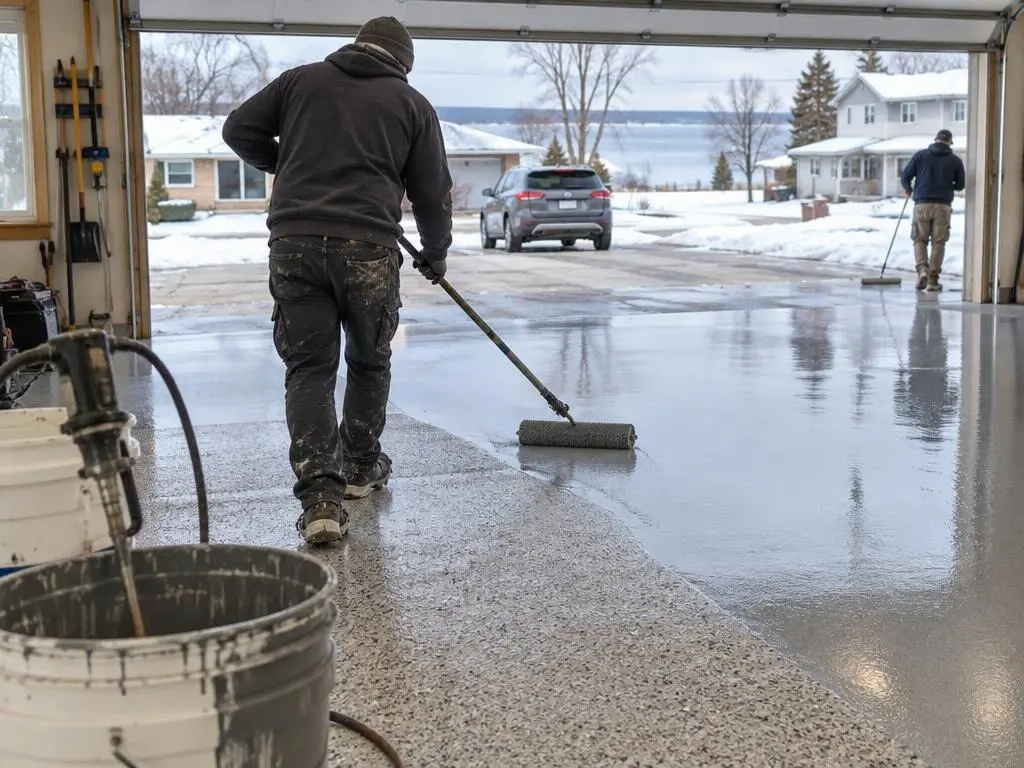
January in Appleton averages a high of 25.4°F and a low of 10.0°F, with 12.6 inches of snow in that month alone. Many people only think about their garage floor in the middle of winter, when it is wettest and saltiest. We can often still do the work. In an attached garage that shares a wall with a heated house, the slab may stay warm enough with some help. We measure the slab temperature, run heat ahead of time when it makes sense, and choose a polyaspartic system that tolerates cooler conditions. In a detached garage with no heat, we usually book you for the first warm stretch of spring and give you the quote now so you are on the schedule.
Big lower levels and home businesses
Some Appleton basements run the full footprint of the house and get used as gyms, playrooms, storage or a home office for a small business. Larger floors are where system choice changes the price most. A solid color epoxy costs less per square foot than metallic or full flake. We price each option on the same written quote so you can compare.
What we ask at the estimate
- When was the house or garage built, and has the floor ever been painted, sealed or coated?
- Does water ever stand in the garage or show up in the basement after a thaw?
- Will the floor see a car, a work bench, a gym or a forklift?
- Do you need the space back by a certain day?
The answers, plus a look at the slab, set the system and the price. You get it in writing before anything is scheduled. Call (920) 587-7291 to set up a visit anywhere in Appleton.
What to Know About Floors in Appleton
- Settled 1847, a city since 1857. Appleton was settled in 1847, incorporated as a village in 1853 and as a city on March 2, 1857, so its housing spans more than 170 years of building.
- 31,747 housing units. The 2020 census counted 31,747 housing units in the city with 4.4% vacant, and a population of 75,644, the sixth largest in Wisconsin.
- A city in three counties. Appleton is the Outagamie County seat and also extends into Calumet and Winnebago counties, with 11,304 residents in the Calumet County part in 2020.
- Big temperature range. Records run from −32°F in 1929 to 107°F in 1936, with 49.4 inches of average annual snowfall and 33.15 inches of precipitation.
Appleton Questions
My Appleton garage is from the 1920s. Can it still be coated?
Usually. Old detached garages often have thin, uneven slabs with old paint and pits. We grind the surface, fill the low spots and pits, and use a flake system that hides unevenness. If a section has heaved or broken through, it needs concrete repair before we coat it, and we will tell you that at the estimate.
I have a welder and a grinder in my garage. Will a coating survive?
A thin coating will not. For a working shop we use a thicker 100% solids epoxy base with flake and a hard topcoat, which handles spatter, oil and rolling tool chests much better. Hot slag can still mark any coating, so a welding mat in the spot where you work most is a good idea.
Does it matter which county my Appleton address is in?
Not for the floor. We work in the Outagamie, Calumet and Winnebago County parts of the city the same way. The slab's age, condition and moisture are what change the job.
Free Estimates in Appleton, WI
On-site estimates anywhere in Appleton, from the river neighborhoods to the newest subdivisions.
Epoxy Flooring Near Appleton
- Epoxy Flooring in Grand Chute, WI
- Epoxy Flooring in Neenah, WI
- Epoxy Flooring in Menasha, WI
- Epoxy Flooring in Fox Crossing, WI
- Epoxy Flooring in Kaukauna, WI
- Epoxy Flooring in Little Chute, WI
- Epoxy Flooring in Kimberly, WI
- Epoxy Flooring in Combined Locks, WI
- Epoxy Flooring in Harrison, WI
- Epoxy Flooring in Sherwood, WI
- Epoxy Flooring in Greenville, WI
- Epoxy Flooring in Hortonville, WI
- Epoxy Flooring in Freedom, WI
- Epoxy Flooring in Buchanan, WI
- Epoxy Flooring in Clayton, WI
- Epoxy Flooring in Oshkosh, WI
- Epoxy Flooring in Winneconne, WI
- Epoxy Flooring in De Pere, WI
- Epoxy Flooring in Wrightstown, WI
- Epoxy Flooring in New London, WI
- Epoxy Flooring in Black Creek, WI
- Epoxy Flooring in Chilton, WI